
It is the beginning of 1975 and Stelio Belletti has not even two years ago officially started the activity of bike frame maker under the Stelbel brand name in his workshop in Rodano, on the outskirts of Milan. The method of making frames with TIG welds intrigues and, although some are still skeptical about the choice of making bicycles without lugs, his creations are admired by enthusiasts and professionals who appreciate their lightness, rigidity, and reliability, qualities that are certainly ideal for racing. But this is the stuff of cycling exegeses: the production is still – and always will remain – refined, cared for, and limited.
At the same time, but a thousand kilometers away, behind the Iron Curtain, the Polish Cycling Federation was in search of a frame supplier.
Polish Cycling Federation president Włodzimierz Gołębiewski and Vice President of Sports Henryk Różycki tasked Osvaldo Cazzaniga, a mechanic of the federation, who had his workshop in Gorgonzola (and later founder of the OSCA brand), with finding better frames.
Cazzaniga takes up the challenge, gets behind the wheel of his station wagon, and heads straight for Italy, knocking on the door of the Stelbel workshop: ‘Stelio, they tell me your frames are a blast! I’d like to commission a set from you for my riders: we’re aiming for the World Championship in Belgium’.
It must be remembered that, in those glorious days, the road races were the prerogative of the various Belgians Merckx, Maertens, and De Vlaeminck, who wanted to make a good impression at home. But the team time trial is the prerogative of the teams that come from Eastern Europe and ‘pull’ like trains: the Soviet Union, East Germany, Czechoslovakia, and Poland.
Belletti, of a calm nature, thinks about it for a while: his company is taking its first steps, time is short and the risk is great. But – what the heck! – he has never shied away from a challenge. Aware of his ability and inspired by the media coverage that such an event could bring to Stelbel, he accepted and set to work immediately, producing the required frames in a very short time.
This led to 27 August 1975. In the town of Yvoir (which together with Mettet hosts the competition), riders Tadeusz Mytnik, Mieczysław Nowicki, Ryszard Szurkowski, and Stanislaw Szozda are lined up at the start on Stelbel bicycles, ready for the team time trial.
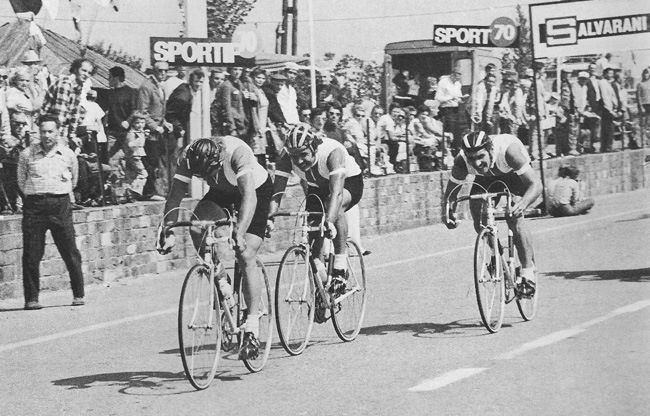
This brings us to August 27, 1975. In the small town of Yvoir (which hosted the competition alongside Mettet), riders Tadeusz Mytnik, Mieczysław Nowicki, Ryszard Szurkowski, and Stanislas Szozda lined up at the start on Stelbel bicycles, ready for the Team Time Trial.
Their red and white Integrale models, featuring a custom-built fork and dropouts welded directly onto the chainstays, stood out among a myriad of other bikes, drawing the gaze of both fans and rivals. Ahead of them lay a 100 km course winding through the countryside, amidst cultivated fields and rolling hills.
Stelio was proud, but also a bit anxious: Cazzaniga had arrived in Belgium with the frames loaded into the trunk of his station wagon just the night before the race, assembling the bikes for the riders overnight.
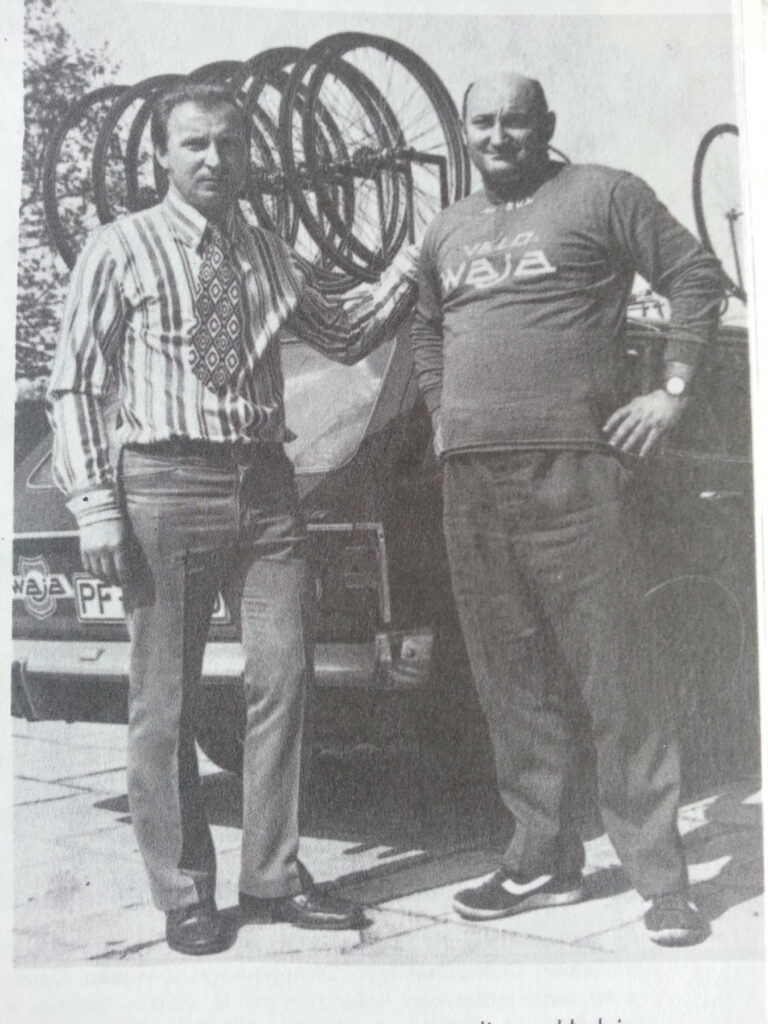
There was no time for extensive testing; how would the Stelbel frames hold up in a full-gas time trial? The average speed was bound to be high, putting immense stress on the components—especially the drivetrain and wheels. But there was no more time for second-guessing. Ready, set… go!
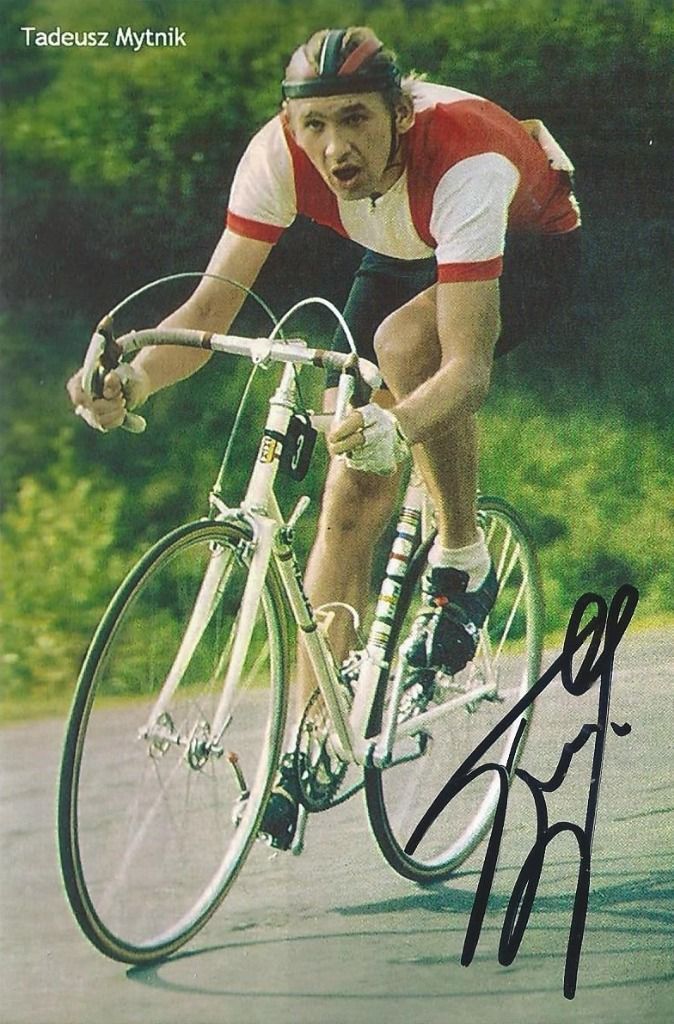
The group set off as a tight-knit pack under the Walloon summer sun, riding between two lines of cheering spectators. In the Poles’ crosshairs was the ‘Big Mama’—the Soviet Union, the team to beat. Compared to those used previously, the Stelbel frames were extremely stiff and fast, proving highly effective in a time trial like that one.
‘It happened in the blink of an eye,’ recalls Mieczysław Nowicki. ‘At one point, Staszek Szozda broke a spoke in his wheel.’

Fortunately, thanks to the experience gained on the velodrome track, the spokes had been tied and soldered. It didn’t bother him too much, but he felt a bit uneasy and wanted to stop to replace it. But we were racing on a razor’s edge, and I remember my reprimand was harsh because there was no time to lose. In fact, I screamed at him: ‘Keep pedaling!’ And that’s how we reached the finish line, without any further trouble.

‘It was a blink of an eye,’ recalls Mieczyslaw Nowicki. ‘At one point Staszek Szozda broke a wheel spoke. Luckily, thanks to Mieczysław Nowicki velodrome experience, spokes were tied and soldered. It didn’t bother him much, but he felt a bit uncomfortable and wanted to stop and replace the wheel.

The decision not to change the wheel proved providential: the Polish team stopped the clock a mere 5 seconds ahead of the Soviet Union. A razor-thin margin.
World Champions!
The red and white of the Polish flag fluttered high in the wind, above all others; the gold medal gleamed around the necks of the four champions who had come from behind the Iron Curtain to lift Stelbel onto the top step of the podium.
Stelbel frames were also used throughout the entire 1976 season, the year the Polish team—still made up of Tadeusz Mytnik, Mieczysław Nowicki, Stanisław Szozda, and Ryszard Szurkowski—won the silver medal at the Olympic Games in Montreal, Canada. But that is another story…
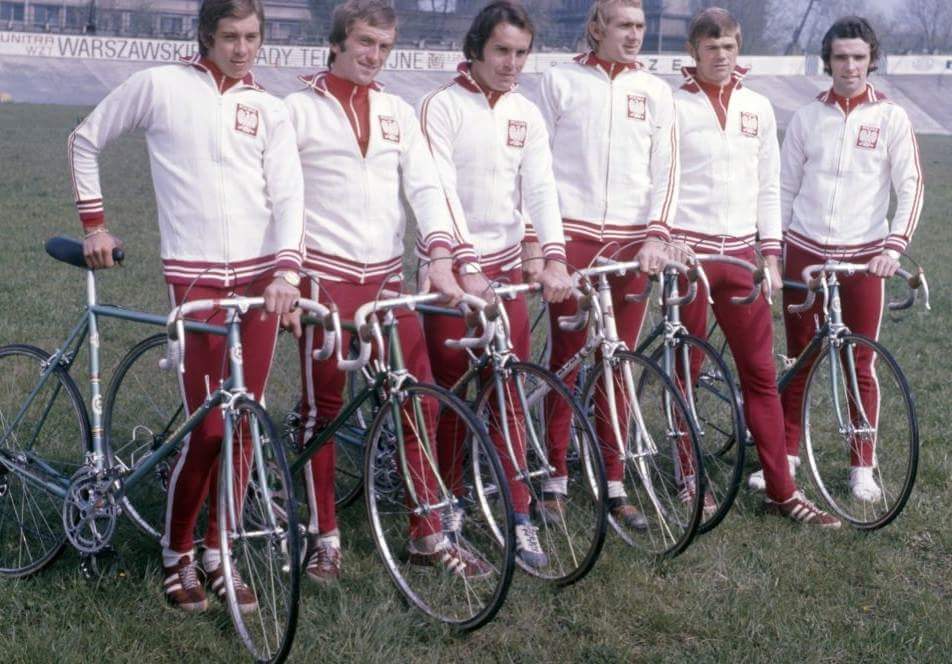
The white and red of the Polish flag fluttered in the wind, higher than anyone else; the gold medal glittered around the necks of the four standard bearers who had come from behind the Iron Curtain to take Stelbel to the top step of the podium.
Stelbel frames were also used throughout the 1976 season, when the Polish team – again consisting of Tadeusz Mytnik, Mieczysław Nowicki, Stanisław Szozda, and Ryszard Szurkowski – won the silver medal at the Olympic Games in Montreal, Canada. But that’s another story…

