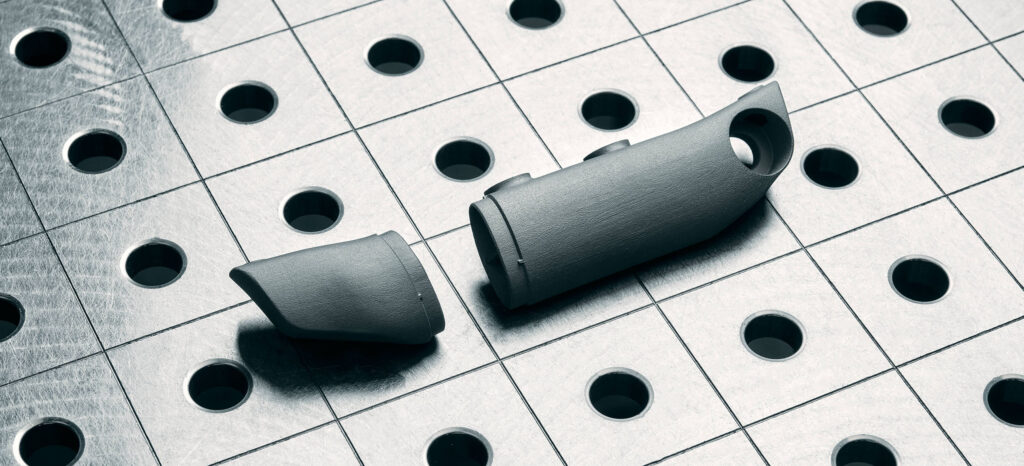
3D Printing, but with discretion
In recent years, 3D printing has become an increasingly widespread presence in the cycling industry. We too have closely observed this technology, recognizing its advantages but maintaining, at least initially, a certain distance.
We were not among the first to adopt it. And not for a lack of interest. The doubt was simple: to what extent is it coherent to delegate the construction of a frame that was born to be handmade to a machine? In our opinion, there is a substantial difference between building a frame and assembling one. And we do not want to assemble frames.
Finding the balance
For a long time, we wondered where the “squaring of the circle” could be found. The answer came through experimentation. We understood that 3D printing could become a tool to improve structural characteristics and dimensional precision without replacing the work of the frame builder.
Today, we use it exclusively for the production of the rear dropouts.
This choice allows us to intervene in a key area of the frame—the rear triangle—improving stiffness and reducing weight. At the same time, we have been able to significantly increase the alignment and dimensional precision of the component.
One of the most interesting aspects concerns the management of deformations induced by welding heat. Every welded metal element undergoes inevitable dimensional variations. Thanks to digital design and 3D printing, we can predict these deformations, compensate for them already in the design phase, and obtain a more precise final result once the welding is complete.
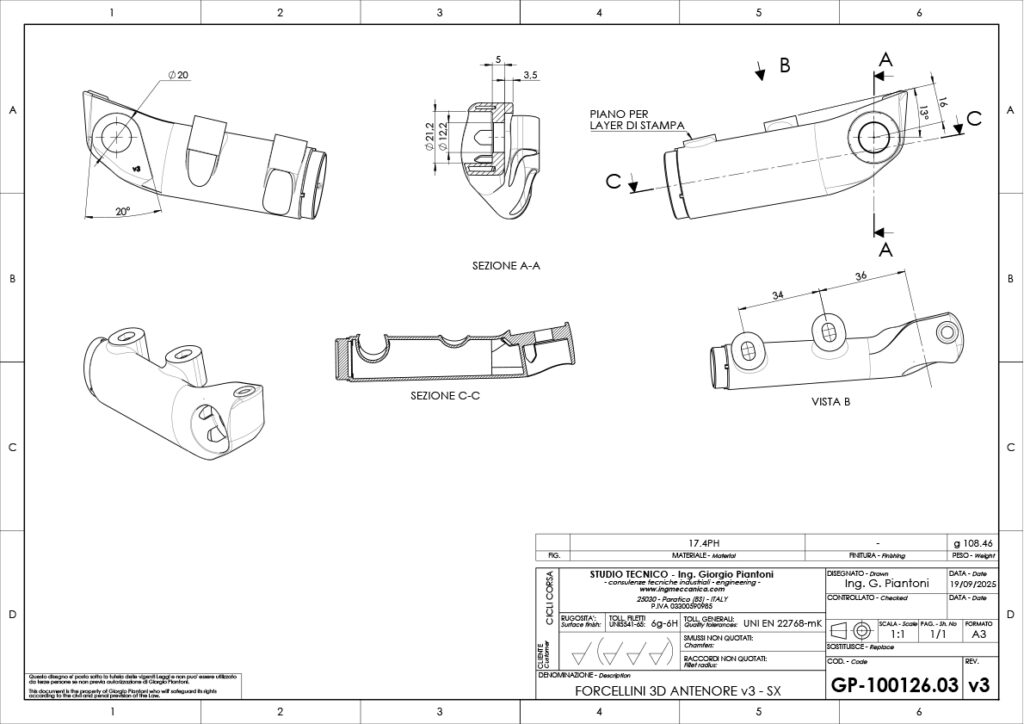
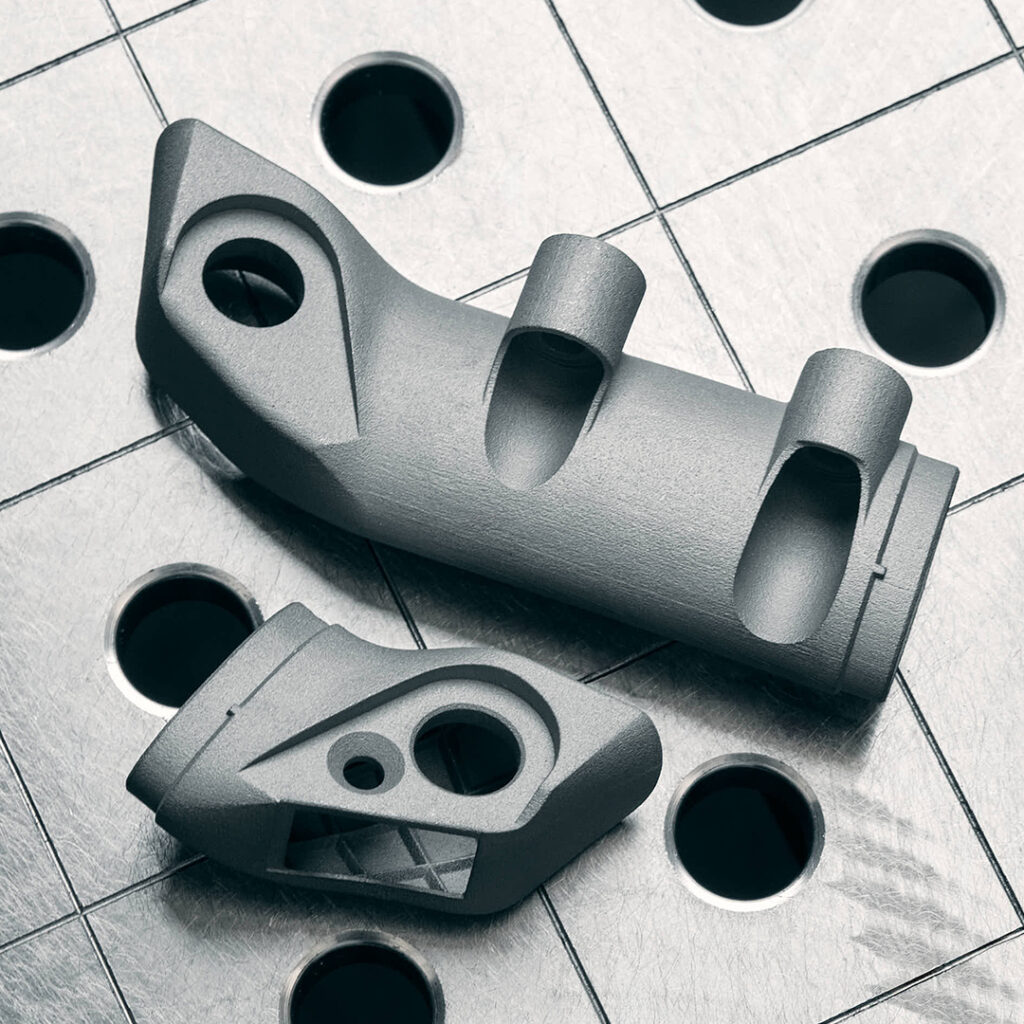
Technical drawing of the left dropout, the pair used on the SB/04.
Binder Jetting and 17-4PH Steel
On the SB/04 and Antenore models, we integrate 3D-printed dropouts produced using Binder Jetting technology, crafted from 17-4PH steel alloy.
This is a high mechanical strength alloy, particularly suited to components subjected to heavy loads and repeated stress cycles. Binder Jetting technology makes it possible to achieve complex geometries, targeted weight reduction, and optimized cross-sections—results that would be impossible to obtain through traditional manufacturing without compromise.
The outcome is a component that is lighter, stiffer, and dimensionally more precise.
The human touch remains central.
For us, 3D printing is a tool. Not an end in itself.
The builder’s hand must be visible and felt in every single creation. Tube preparation, precise miter cutting, the manual fitting of joints, and the quality of the welding remain the very heart of every Stelbel.
The 3D-printed dropout does not replace this craftsmanship. It elevates it.
We continue to build frames, not assemble them.
Technology is introduced only when it makes sense, when it tangibly improves the final result, and when it can coexist with the artisanal tradition that defines our brand.
For us, innovation and manual skill are not in contradiction.
They must be in balance.


