
There is an hour, in autumn, when the light over the Bergamo hills turns oblique and golden, and the roads climbing toward the pre-Alps seem drawn specifically to be ridden by bicycle. It is an hour that those who cycle in these parts know well. There is no need to name the passes, no need to list the hairpin bends: anyone who has put their feet on the pedals in this land knows exactly what we mean.
Cycling here is not a sport. It is an integral part of local culture.

A land that has always pedalled
Bergamo sits at a precise point in the Italian landscape: where the Po Valley meets the first ridges that will eventually lead to the Alps proper. It is a threshold. And like all thresholds, it is a place where things are learned. You learn to climb, because the climbs begin immediately. You learn to measure effort, because the gradients here leave no room for improvisation. Above all, you learn to see the bicycle as an instrument for understanding the territory.
Perhaps this is why cycling has taken such deep root here. It did not arrive as a trend: it was already here, already in the legs of those who cycled to work in the postwar years, already in the Sundays of those who rode up to the sanctuary in canvas shoes with spare tubulars wrapped under the saddle. From those Sundays emerged champions who wrote entire chapters in the history of this sport. Felice Gimondi, above all: a native of Sedrina in the Bergamo province, one of the few riders in the world to have won all three Grand Tours, a figure whose name, even today, makes those who learned to ride here lower their voices in reverence.
Beneath the champions there has always been — and still is — a widespread cycling population: village sports clubs, gran fondo riders, groups that set off at dawn on Sunday mornings. This is the humus that has made eastern Lombardy what it is: a land where the bicycle is a common language. And then there are the great races. The Giro d’Italia regularly passes through these roads, and when it does, it does not pass as an outside event: it passes as an acknowledgement. And every autumn, when the leaves begin to fall, comes the Giro di Lombardia — the Race of the Falling Leaves, the most poetic monument on the calendar, the one that closes the season and finds its natural home right here, among the lakes and the climbs that give it shape.
The Italian school
This intensity of lived cycling has produced, almost inevitably, a consequence: where people ride a great deal, a great deal is built. And where a great deal is built, sooner or later, it is built well.
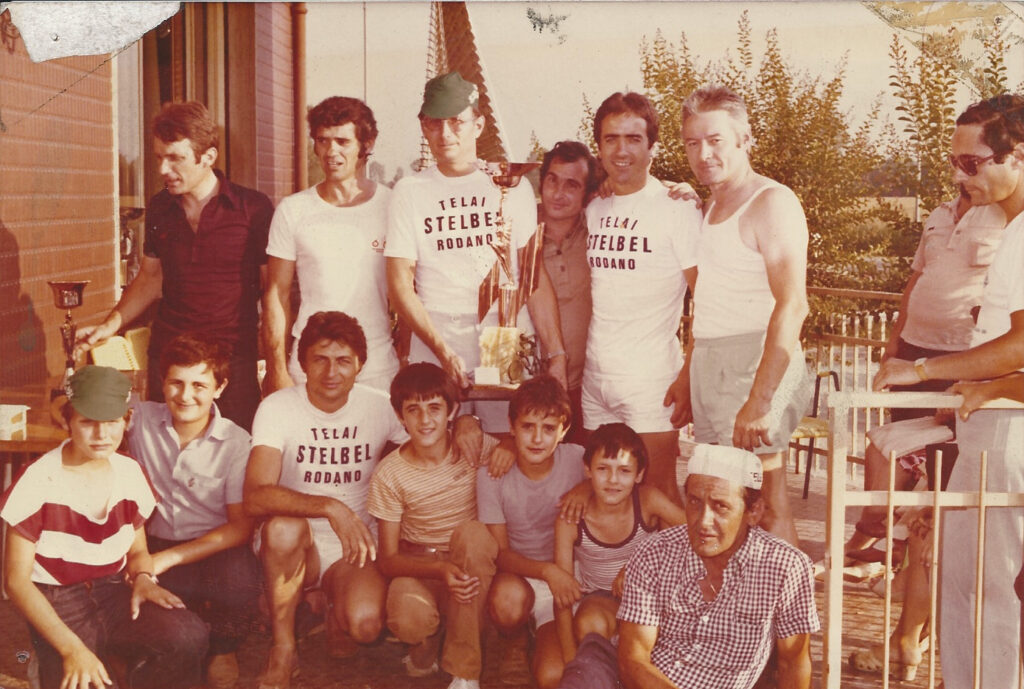
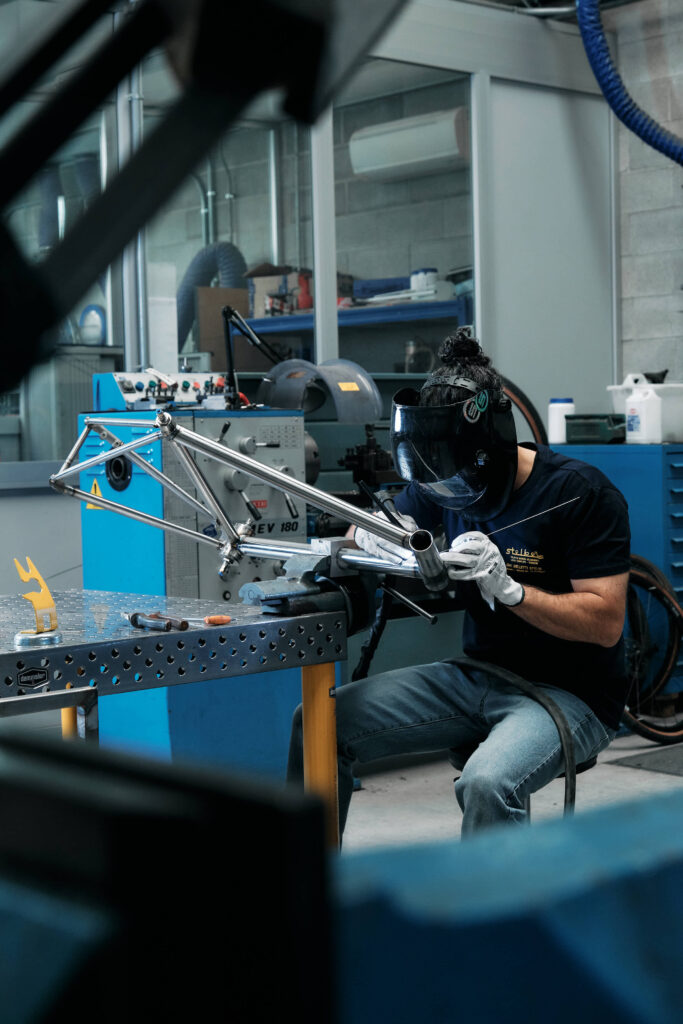
The Italian framebuilding school, in the Seventies and Eighties, was the worldwide reference for anyone who wanted a racing frame. It was not a matter of marketing or nationalism: it was a matter of hands. Scattered throughout the peninsula — but with a particular concentration in Lombardy and the Veneto — there were craftsmen who had learned the trade from those who had learned it in turn from masters of the previous generation. They were welders, file workers, skilled technicians: men who knew their materials the way a musician knows their instrument, through the smallest hesitations, through the way they respond to the flame, through how they behave when asked to bend.
From those workshops came the frames on which professional riders raced and won on the world circuit. Made in Italy, in cycling, was never a slogan: it was a technical truth. It meant geometries designed for those who truly race, hand-finished craftsmanship, obsessive attention to the detail of the lug, the paintwork, the balance between stiffness and elasticity.
Bergamo occupies a precise place in this geography of Italian cycling craftsmanship. Here, alongside historic industry brands — Bianchi, the oldest in the world, founded in 1885, is a product of the same Lombard culture — there has existed and continues to exist a network of framebuilders who have kept the knowledge of the hand alive.


